
The Meaning of Boudoir: From Historical Architecture to Sensual Photography
Long before "boudoir" was a style of intimate photography, it meant a room: a woman's private sitting room or dressing room, hers alone, in the great houses of 18th-century France. The origin of the boudoir has a long history, but the short version is that it was one of the only spaces where a woman of the time could exist entirely on her own terms, away from an audience. The word "boudoir" has an ironic origin that I wrote about elsewhere.
That idea — a private space, free of anyone else's expectations — didn't stay confined to architecture for long. Over the past century and a half, it moved through painting, into the earliest days of art photography, and eventually into the genre you'd recognize today. Here's how that happened and why it still shapes the way I approach a boudoir session.
Where Privacy Met Sensuality
A private room, by nature, invites a certain kind of imagination — real and projected alike. Painters of the late 19th century picked up on this. Delphin Enjolras, in particular, became known for depicting women in soft lamplight, arranging their hair or gazing into a mirror, in scenes clearly set within a private, intimate room. These paintings were romantic and, filtered largely through the male gaze of the era, unmistakably sensual.

Artwork by French painter Delphin Enjolras (1857-1945). Left: “In the Boudoir”. Right: “In Front of the Mirror” [public domain]
Literature followed the same thread. 18th-century French novels used the boudoir as a setting for secrecy and seduction, whether or not that reflected how the rooms were actually used. By the time photography arrived on the scene, the association between "private room" and "intimate, sensual space" was already well established culturally.
From Painting to Photography
The late 1800s were a turning point for how women were depicted in visual art — the Art Nouveau movement leaned into flowing lines, soft light, and dreamlike femininity, and photography, still a young medium, began borrowing that same visual language.
Photographers like Félix-Jacques-Antoine Moulin, active in the 1850s, were among the first to attempt artistic nude photography — work that was controversial and, at times, censored, but that planted an important idea: a camera could be used not just to document a person, but to interpret and idealize them, the way a painter would.
By the early 20th century, photographers like Alfred Stieglitz, Edward Steichen, and Gertrude Käsebier led the Pictorialist movement, pushing to have photography recognized as a fine art. They used soft focus, atmospheric lighting, and painterly compositions — visual language that would later influence the look of modern boudoir photography.
It's also around this period — early 20th-century France — that "boudoir" was first used to describe a style of photograph, not just a room: upper-class women photographed in their private salons, in a visual language shaped by the Art Nouveau movement's soft, romantic take on femininity.
It's worth being honest that this early version of boudoir photography was closer to erotic postcards and studio photographers like Jacques-Henri Lartigue and Jean Agélou than to anything resembling a private gift between partners — that gentler, client-directed version of the genre wouldn't really emerge for another eighty years.
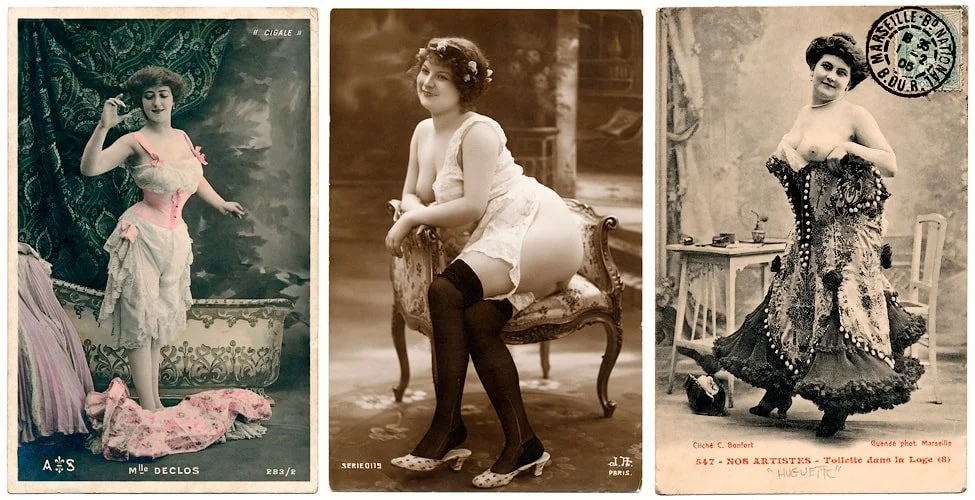
Examples of “naughty” French postcards that became connected to the term “boudoir”. [public domain]
Toward the Modern Genre
Boudoir photography kept evolving through the 20th century. World War II brought pin-up photography into the mainstream — glamorous, playful, and designed to boost morale — which normalized sensual imagery in popular culture in a way that hadn't existed before.
By the 1970s and 80s, wedding photographers began offering "for his eyes only" sessions, letting brides surprise their partners with intimate portraits — the first version of boudoir as a service offered to everyday women, not just the aristocracy or the occasional artist's muse. Lingerie itself was changing too; brands like Victoria's Secret, founded in 1977, reframed lingerie as something meant to be seen, not just worn.
That era overlapped with the feminist movement and the earliest waves of body positivity, and the genre's whole framing started to shift — from "for someone else" to "for yourself." By the 1990s and 2000s, boudoir had become its own recognized genre, less about seduction and more about identity and confidence.
Then came Instagram. Nearly every client I've worked with tells me some version of the same story: they first knew boudoir photography existed because they saw it on Instagram. That's not a small footnote — a genre that spent a century evolving in galleries, magazines, and the occasional private commission suddenly had a platform built entirely around sharing images publicly.
Instagram didn't just make boudoir more visible; it changed who saw themselves in it, and normalized a genre that used to require knowing the right photographer through word of mouth alone.
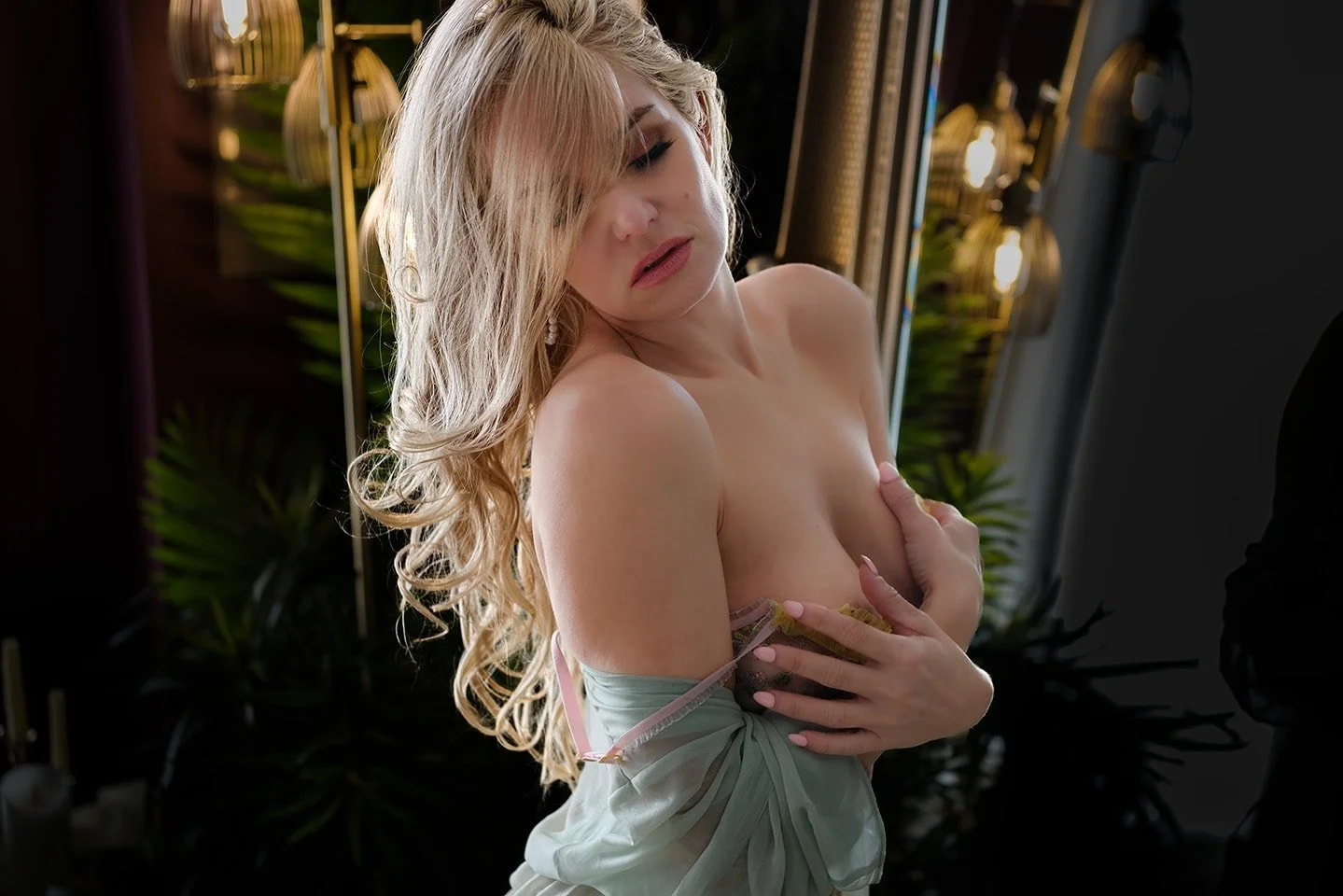
Modern boudoir session [photo by the author]
What This History Means for My Photography Today
Knowing this history shapes how I actually approach a session. When I'm behind the camera, I'm not thinking about poses or trends — I'm thinking about that original idea of a private room: a place where someone could exist entirely on their own terms, away from judgment or performance. That's what I want a session with me to feel like.
I treat every boudoir session as the creation of a piece of art, not an imitation of something trending online. That means natural light, real emotion, and posing that feels like you, not a pose you saw and copied. You won't see me directing "legs up the wall" or the kind of shots designed purely to get attention — they might, but they don't feel real, and real is the whole point.
The studios I work from reflect that same philosophy. My Baltimore studio is styled like a chic downtown apartment — rich colors, artful decor, cozy textures — and it happens to sit a few blocks from the Walters Art Museum, which I visit often enough after a shoot that I wrote a whole post about it. My Elkridge studio takes a more classic approach, with an antique claw-foot tub that's become a client favorite and natural light that flatters every skin tone.
Both spaces, and every session in them, trace back to that same original idea: a private room, entirely your own, where you get to simply be yourself.
